A collaborative research team from China has published a new analysis that shows the Earth's climate would increase by 4 °C, compared to pre-industrial levels, before the end of 21st century.
The levels of future global warming relative to the pre-industrial period have been extensively addressed, in which 2 C and 1.5 C warming have attracted the most attention. A special report 'Turn Down the Heat: Why a 4°C Warmer World must be Avoided' by the World Bank in 2012 described a 4 C warmer world with significant changes in mean and extreme climates on the basis of earlier-generation climate models and emission scenarios [Credit: ParabolStudio/Shutterstock]
To understand the severity of this, consider the Paris Agreement of the United Nations. It's a global effort to prevent an increase of 2°C. Nearly every country on the planet--the United States is the only country to withdraw--has agreed to work to prevent the catastrophic effects of two degrees of warming.
"A great many record-breaking heat events, heavy floods, and extreme droughts would occur if global warming crosses the 4 °C level, with respect to the preindustrial period," said Dabang Jiang, a senior researcher at the Institute of Atmospheric Physics of the Chinese Academy of Sciences. "The temperature increase would cause severe threats to ecosystems, human systems, and associated societies and economies."
In the analysis, Jiang and his team used the parameters of scenario in which there was no mitigation of rising greenhouse gas emissions. They compared 39 coordinated climate model experiments from the fifth phase of the Coupled Model Intercomparison Project, which develops and reviews climate models to ensure the most accurate climate simulations possible.
They found that most of the models projected an increase of 4°C as early as 2064 and as late as 2095 in the 21st century, with 2084 appearing as the median year.
This increase translates to more annual and seasonal warming over land than over the ocean, with significant warming in the Arctic. The variability of temperature throughout one year would be lower in the tropics and higher in polar regions, while precipitation would most likely increase in the Arctic and in the Pacific. These are the same effects that would occur under 1.5°C or 2°C increases, but more severe.
"Such comparisons between the three levels of global warming imply that global and regional climate will undergo greater changes if higher levels of global warming are crossed in the 21st century," wrote Jiang.
The researchers continue to investigate the changes associated with 4°C of global warming in extreme climates.
"Our ultimate goal is to provide a comprehensive picture of the mean and extreme climate changes associated with higher levels of global warming based on state-of-the art climate models, which is of high interest to the decision-makers and the public," said Jiang.
Coyotes now live across North America, from Alaska to Panama, California to Maine. But where they came from, and when, has been debated for decades. Using museum specimens and fossil records, researchers from the North Carolina Museum of Natural Sciences and North Carolina State University have produced a comprehensive (and unprecedented) range history of the expanding species that can help reveal the ecology of predation as well as evolution through hybridization. Their findings appeared in ZooKeys.
A coyote in Yosemite National Park, California, USA [Credit: Christopher Bruno]
The geographic distribution of coyotes has dramatically expanded since 1900, spreading across much of North America in a period when most other mammal species have been declining. Although this unprecedented expansion has been well documented at the state/provincial scale, the continent-wide picture of coyote spread was coarse and largely anecdotal. A more thorough compilation of available records was needed.
"We began by mapping the original range of coyotes using archeological and fossil records," says co-author Dr. Roland Kays, Head of the Museum's Biodiversity Lab and Research Associate Professor in NC State's Department of Forestry and Environmental Resources. "We then plotted their range expansion across North America from 1900 to 2016 using museum specimens, peer-reviewed reports, and game department records." In all, Kays and lead author James Hody reviewed more than 12,500 records covering the past 10,000 years for this study.
Ranges are based on occurrence of museum specimens, peer-reviewed literature with associated specimens or photographs, and reports from state game departments. The distribution of coyotes between the Yucatán Peninsula and Nicaragua is coarsely depicted due to the paucity of available data, representing the earliest confirmed occurrence [Credit: James Hody]
Their findings indicate that coyotes historically occupied a larger area of North America than generally suggested in the literature. Previous maps, as it turns out, had ancient coyotes only located across the central deserts and grasslands. However, fossils from across the arid west link the distribution of coyotes from 10,000 years ago to specimens collected in the late 1800s, proving that their geographic range was not only broader but had been established for hundreds, perhaps thousands of years, which also contradicts some widely-cited descriptions of their historical distribution.
It wasn't until approximately 1920 that coyotes began their expansion across North America. This was likely aided by an expansion of human agriculture, forest fragmentation, and hybridization with other species. Eastern expansion in particular was aided by hybridization with wolves and dogs, resulting in size and color variation among eastern coyotes.
Before too long, coyotes may no longer be just a North American species. Kays notes that coyotes are continually expanding their range in Central America, crossing the Panama Canal in 2010. Active camera traps are now spotting coyotes approaching the Darien Gap, a heavily forested region separating North and South America, suggesting that they are at the doorstep of South America.
"The expansion of coyotes across the American continent offers an incredible experiment for assessing ecological questions about their roles as predators, and evolutionary questions related to their hybridization with dogs and wolves," adds Hody. "By collecting and mapping these museum data we were able to correct old misconceptions of their original range, and more precisely map and date their recent expansions.
"We hope these maps will provide useful context for future research into the ecology and evolution of this incredibly adaptive carnivore."
From baby elephants to sun bears and pangolins, escalating demand for bushmeat in towns and cities is taking an increasingly heavy toll on some of Cambodia’s most endangered wildlife.
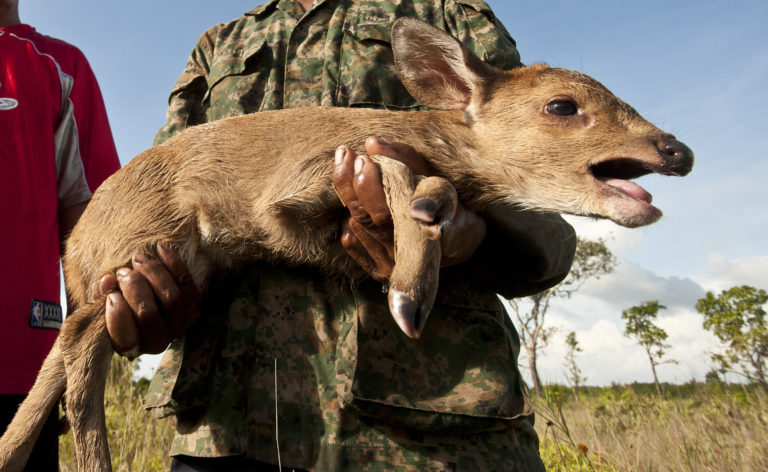
Cambodia’s remaining hog deer is population is under severe hunting pressure [Credit: Jeremy Holden/FFI]
The extensive and growing use of snares to supply the burgeoning bushmeat market is resulting in the indiscriminate slaughter of wildlife, including Asian elephant calves and other species injured and killed accidentally in wire traps set for other animals.
Groundbreaking research commissioned by Fauna & Flora International (FFI), the first of its kind in Cambodia, has paved the way for a behaviour change campaign to reduce consumption of wild meat. The research has provided vital insights into the phenomenon of bushmeat consumption, shedding light on who eats what, and why.
Bushmeat consumption in Cambodia is not driven by the subsistence needs of impoverished rural communities, who typically rely on fish as their main source of protein. In fact, it is mainly a recreational activity associated with male-dominated gatherings of friends, work colleagues or family members. The practice is linked with peer pressure, social status and – among the elite – the perceived health benefits of eating wild rather than farmed meat.
Sunda pangolins are among the many species snared to supply the demand for bushmeat [Credit: Tim Knight]
Almost half of the 24 different wild animals mentioned by the Phnom Penh citizens interviewed during the research stage of the project are threatened with extinction. Several, including the Sunda pangolin – the world’s most trafficked mammal – are officially categorised as Critically Endangered on the IUCN Red List.
Many of those interviewed were oblivious to the fact that some of these animals are on the brink and saw no reason why a previously plentiful resource shouldn’t continue to be readily available. Some of the more knowledgeable consumers are well aware of the increasing scarcity of certain species, but actually regard this as an essential part of their appeal; the prevailing attitude in this case appears to be ‘Buy now while stocks last’.
FFI and its local partners are among the many organisations working to protect Cambodia’s threatened species and habitats through a combination of community engagement, anti-poaching measures and support for improved law enforcement.
The bushmeat trade poses a threat to critically endangered Siamese crocodiles [Credit: Jeremy Holden/FFI]
But there is increasing recognition that interventions such as snare removal and prosecution of individual poachers have limited impact in the face of demand-driven commercial hunting. The authorities’ capacity to tackle organised, large-scale wildlife crime is constrained by a shortage of resources and, in some instances, by corruption.
Until now, there has been no real attempt to tackle the problem from a consumer perspective in order to reduce demand for wildlife products in Cambodia. Having identified this gap in the market, FFI is formulating a consumer-focused strategy to complement other, more traditional, approaches to combating illegal wildlife trade. The main target for these activities will be regular consumers in Phnom Penh.
The research techniques employed in compiling the report have been widely utilised in the private sector but are relatively untried in a conservation context. FFI’s Flagship Species Manager, Jackson Frechette, has no doubt about the value of the research: “The findings will be crucial in enabling FFI and partners to decide how best to communicate with the different categories of consumer in order to bring about a change in attitude towards their country’s rich and valuable natural heritage.”
Animal and plant species are vanishing at an accelerating pace around the world - sometimes even before we know that they exist - but conservationists are pushing back against the juggernaut of mass extinction.
Madagascar's greater bamboo lemur was long thought to have been extinct until it was rediscovered in 1986 [Credit: Russell A. Mittermeier/AFP]
From captive breeding to satellite tracking; restoring habitats to removing predators; shaming multinationals to nursing baby pandas and orangutans -- in all these ways, scientists and others have given a second chance to creatures under threat.
Take the Mauritius kestrel, a svelte and dappled falcon reduced to a population of just four, including one breeding female, in 1974 by a perfect storm of human meddling.
The keen-eyed predator lost much of its natural habitat when settlers clear-cut the Indian Ocean island's forests in the 18th century.
What pushed the bird to the brink, however, was the widespread use of the pesticide DDT in the 1950s, as well as invasive species such as cats, mongooses and crab-eating macaques with a taste for the birds and their eggs.
But a combination of captive breeding, food supplements, nest improvements and predator control has increased the bird's numbers to about 400, making it one of the most successful bird restoration projects in history.
On nearby Madagascar, the greater bamboo lemur -- aka the broad-nosed gentle lemur -- has also made a fairy-tale comeback.
Long thought to be extinct, the dark-furred primate -- which has tufted, white-tinged ears -- was "rediscovered" in 1986 in the island nation's southeastern Ranomafana region.
True to its name, the lemur is a "bamboo specialist" that feasts almost exclusively on a single species of the fibrous, quick-growing plant. Scientists are still trying to figure out how the brown-eyed tree-dweller metabolises the quantities of cyanide -- enough to kill a human adult -- found in a day's diet of bamboo shoots.
The population of the Ethiopian wolf, Africa's most endangered carnivore, was wiped out by disease spread from domestic dogs [Credit: Timothy J.Colston/AFP]
Unfortunately the lemur is still hanging by a "critically endangered" thread, isolated in four percent of its historic range. But the creation of a national park around the area where it was found has boosted its chances of survival.
Across the board, biodiversity is declining. To date, the International Union for the Conservation of Nature (IUCN) has evaluated nearly 80,000 animals and plants, cataloguing their conservation status on its famous Red List of endangered species.
Some 23,000 - nearly a third - are threatened with extinction, including 41 percent of amphibians, 34 percent of conifers, 33 percent of reef building corals, 25 percent of mammals, and 13 percent of birds.
"The sixth mass extinction is happening now," Craig Hilton-Taylor, head of the Red List, told AFP ahead of the International Day for Biological Diversity on May 22.
"But these conservation achievements highlight that there is still reason to be hopeful for the future of our planet, and that conservation does work."
It certainly helped keep the Ethiopian wolf from suffering the same fate, for example, as the Tasmanian tiger.
Canis simensis is Africa's most endangered carnivore, and probably the most endangered canid -- a family that includes dogs, wolves, jackals, foxes and coyotes -- in the world.
This elusive hunter lives only in the highlands of Ethiopia, notably in the Bale Mountains, where 200 individuals are monitored 24/7 by the Ethiopian Wolf Conservation Programme.
Disease that spread from domestic dogs has wiped out nearly a third of the wolf's population in recent years, but conservation efforts have secured its habitat and raised awareness among local peoples.
Critically endangered South American forests thought to be the result of climate change were actually spread by ancient communities, archaeologists have found.
Campos da Serra y Floresta de Araucari [Credit: Copyright Jose Iriarte]
Huge swathes of land in Chile, Brazil and Argentina are covered with millions of Araucaria, or monkey puzzle trees, thanks to people planting or cultivating them more than a thousand years ago, a new study shows. Recent logging means the landscape is now one of the world's most at-risk environments.
It had been thought the forests expanded due to wetter and warmer weather. But the research shows the rapidly expanding pre-Columbian population of South America, Southern Jê communities, were really responsible.
New excavations and soil analysis shows the forests, still hugely culturally and economically important to people living in South America, expanded between 1,410 and 900 years ago because of population growth and cultural changes.
Dr Mark Robinson, from the University of Exeter, who led the British Academy and AHRC-FAPESP-funded research, said: "Our research shows these landscapes were man-made. Communities settled on grassland, and then - perhaps because they modified the soil, protected seedlings or even planted trees - established these forests in places where geographically they shouldn't have flourished."
Monkey puzzle forests [Credit: Copyright Mark Robinson]
The forests date back to the period when dinosaurs roamed. The iconic monkey puzzle tree, or Parana pine, has grown in the region for thousands of years. Its nuts were one of the most important food sources for ancient communities, attracted game for hunting when nuts were ripe. They were also a valuable source of timber, fuel and resin, and became an integral part of southern Jê cosmology. Communities still call themselves "people of the Araucaria", and hold festivals to celebrate the forests.
Of the 19 species of Araucaria tree, five are classified as endangered and two, including the Brazilian Araucaria angustifolia, are critically endangered. Reports from the late 1800s describe trees with diameters of over 2 m, reaching 42 m in height. Modern trees are only around 17.7 m tall.
The archaeological analysis began because the experts, from the University of Exeter, University of Reading, University of São Paulo, University of New Mexico, Universidade Federal de Pelotas and Universidade do Sul de Santa Catarina, noticed that in areas of low human activity forests are limited to south-facing slopes, whereas in areas of extensive archaeology, forests cover the entire landscape. They were able to analyse soil isotopes reflecting vegetation and archaeological evidence from Campo Belo do Sul, Santa Catarina State, Brazil, to test whether this pattern was directly related to past human activity.
The study shows the forests first expanded around 4,480 to 3,200 years ago, most likely near streams, and this may have been caused by a wetter climate. But a more rapid and extensive expansion across the whole region later happened between 1,410 and 900 years ago, when forests expanded into highland areas. The weather during this time was dry and less humid. This expansion of the forests coincides with population growth and increasingly complex and hierarchical societies in South America.
Monkey puzzle forests [Credit: Copyright Mark Robinson]
The expansion in forests reached a peak around 800 years ago. The number of people in South America declined 400 years ago when European settlers arrived in the area. The population did not begin to recover until the 19 century, when loggers began exploiting the Araucaria forests for timber.
Professor José Iriarte, from the University of Exeter, another member of the research team, said: "This study shows the Araucaria forests were expanded beyond their natural boundaries, they were used sustainably for hundreds of years, and conservation strategies must reflect this so they balance protection, heritage and economic development."
A shocking study in the journal Science by the University of Queensland, Wildlife Conservation Society (WCS), and University of Northern British Columbia confirms that one third of the world's protected areas - an astonishing 2.3 million square miles or twice the size of the state of Alaska - are now under intense human pressure including road building, grazing, and urbanization.
Some of these least impacted protected areas include Madidi National Park in Boliviawhere WCS has made considerable conservation investments and therefore has successfully staved off degradation [Credit: Rob Wallace/WCS]
The study is a reality check for nations striving to meet commitments under the Convention on Biological Diversity (CBD) to halt biodiversity loss through protected area creation. Since 1992, the global extent of protected areas has roughly doubled in size; more than 202,000 cover more than 15 percent of the world's terrestrial area, with a goal of at least 17 percent coverage by 2020.
Though management objectives differ, ranging from strict biodiversity conservation areas to zones permitting certain human activities and sustainable resource extraction, the primary goal of all protected areas is to conserve nature.
The authors looked at global "Human Footprint" maps to make their assessment which shows that 32.8 percent of protected land is highly degraded. For protected areas created before the CBD was ratified 1992, 55 percent have since experienced human pressure increases. The authors warn that CBD goals will be severely undermined if widespread human pressure continues inside protected areas.
Said the paper's lead author, Kendall Jones of University of Queensland: "A well-run protected area network is essential in saving species. If we allow our protected area network to be degraded there is a no doubt biodiversity losses will be exacerbated."
The study shows that governments are overestimating the space available for nature inside protected areas. Governments are claiming these places are protected for the sake of nature when in reality they aren't. It is a major reason why biodiversity is still in catastrophic decline, despite more and more land being 'protected'.
However, the authors are not suggesting that high pressure protected areas be de-gazetted or defunded. To the contrary, it is crucial that nations recognize the profound conservation gains that can be realized by upgrading and restoring degraded protected areas while respecting the needs of local people.
The Good News
The most impacted protected areas were found in Asia, Europe, and Africa in places with massive human populations. But the study did find some good news: protected areas with strict biodiversity conservation objectives are subject to significantly lower levels of human pressure.
Some of these least impacted protected areas include Keo Seima Wildlife Sanctuary in Cambodia, Madidi National Park in Bolivia, and Yasuni Biosphere Reserve in Ecuador - places where WCS has made considerable conservation investments and therefore has successfully staved off degradation.
Said Professor James Watson of WCS and University of Queensland, and the study's senior author: "We know protected areas work - when well-funded, well-managed and well placed, they are extremely effective in halting the threats that cause biodiversity loss and ensure species return from the brink of extinction. There are also many protected areas that are still in good condition and protect the last strongholds of endangered species worldwide. The challenge is to improve the management of those protected areas that are most valuable for nature conservation to ensure they safeguard it."
Protected areas are at the core of WCS's conservation strategy, as these are areas that are most effective at protecting natural ecosystems and their complement of biodiversity and ecosystem services - over 80 percent of WCS's site-based field work takes place within or around protected areas. When well-managed (through sound enforcement, monitoring, clear boundaries) and funded appropriately, protected areas are effective in reducing the loss of natural habitat, and sustaining wildlife populations.
Said Watson: "Most importantly we've got to recognize that these jewels in the crown need support- there are some protected areas that are safeguarding nature and that still haven't got any evidence of human encroachment in them. We must ensure these values are maintained."
Limiting global warming to 1.5°C would save the vast majority of the world's plant and animal species from climate change - according to new research led by the University of East Anglia.
The American pika is considered an indicator species for detecting ecological effects of climate change in mountainous regions [Credits: NPS]
A new report published in Science reveals that limiting warming to the ultimate goal of the Paris Agreement would avoid half the risks associated with warming of 2°C for plants and animals, and two thirds of the risks for insects.
Species across the globe would benefit - but particularly those in Southern Africa, the Amazon, Europe and Australia.
Reducing the risk to insects is particularly important, the team say, because they are so vital for 'ecosystem services' such as pollinating crops and flowers, and being part of the food chain for other birds and animals.
Previous research focused on quantifying the benefits of limiting warming to 2°C above pre-industrial times - the upper limit for temperature as set out in the Paris Agreement - and did not look at insects.
This is the first study to explore how limiting warming to 1.5°C would benefit species globally.
Researchers at UEA and James Cook University in Australia studied some 115,000 species including 31,000 insects, 8,000 birds, 1,700 mammals, 1,800 reptiles, 1,000 amphibians and 71,000 plants in this, the largest scale study of its kind.
Lead researcher Prof Rachel Warren, from the Tyndall Centre for Climate Change Research at UEA, said: "We wanted to see how different projected climate futures caused areas to become climatically unsuitable for the species living there.
"We measured the risks to biodiversity by counting the number of species projected to lose more than half their geographic range due to climate change.
"We found that achieving the ultimate goal of the Paris Agreement, to limit warming to 1.5°C above pre-industrial levels, would reap enormous benefits for biodiversity - much more so than limiting warming to 2°C.
"Insects are particularly sensitive to climate change. At 2°C warming, 18 per cent of the 31,000 insects we studied are projected to lose more than half their range.
"This is reduced to 6 per cent at 1.5°C. But even at 1.5°C, some species lose larger proportions of their range.
"The current global warming trajectory, if countries meet their international pledges to reduce CO2, is around 3°C. In this case, almost 50 per cent of insects would lose half their range.
"This is really important because insects are vital to ecosystems and for humans. They pollinate crops and flowers, they provide food for higher-level organisms, they break down detritus, they maintain a balance in ecosystems by eating the leaves of plants, and they help recycle nutrients in the soil.
"We found that the three major groups of insects responsible for pollination are particularly sensitive to warming.
"If temperatures rise by 3°C, ecosystem services provided by insects would be greatly reduced. Other research has already shown that insects are already in decline for other reasons, and this research shows that climate change would really compound the problem."
The study includes the ability of species to relocate to more suitable locations as the world warms. Birds, mammals and butterflies have the greatest ability to disperse. The dispersal means that a small number of species can gain in range by 2100.
Prof Warren added: "If warming is limited to 1.5°C by 2100 then more species can keep up or even gain in range, whereas if warming reached 2°C by 2100 many species cannot keep up and far more species lose large parts of their range."
Co-author Dr Jeff Price, also from UEA, added: "Examples of animals to really benefit from limiting warming to 1.5 include the critically endangered Black Rhinoceros, which is already highly threatened by poaching and habitat loss.
"There are also species which have been important in evolutionary theory and studied since the time of Charles Darwin, which would benefit from limiting warming to 1.5°C. These include Darwin's Finches of the Galapagos, such as the Large Ground Finch."
A new global, satellite-based study of Earth's freshwater distribution found that Earth's wet areas are getting wetter, while dry areas are getting drier. The data suggest that this pattern is due to a variety of factors, including human water management practices, human-caused climate change and natural climate cycles.
This global map of freshwater stored on land for February 2016 using data from the Gravity Recovery and Climate Experiment [Credit: NASA]
The NASA-led research team, which included Hiroko Beaudoing, a faculty specialist at the University of Maryland's Earth System Science Interdisciplinary Center (ESSIC), used 14 years of observations from the Gravity Recovery and Climate Experiment (GRACE) mission to track global trends in freshwater in 34 regions around the world.
The study, published in the journal Nature, also incorporated satellite precipitation data from the ESSIC-led Global Precipitation Climatology Project; Landsat imagery from NASA and the U.S. Geological Survey; irrigation maps; and published reports of human activities related to agriculture, mining and reservoir operations. The study period spans from 2002 to 2016.
"This is the first time we've assessed how freshwater availability is changing, everywhere on Earth, using satellite observations," said Matt Rodell, lead author of the paper and chief of the Hydrological Sciences Laboratory at NASA's Goddard Space Flight Center. "A key goal was to distinguish shifts in terrestrial water storage caused by natural variability -- wet periods and dry periods associated with El Niño and La Niña, for example -- from trends related to climate change or human impacts, like pumping groundwater out of an aquifer faster than it is replenished."
Freshwater is present in lakes, rivers, soil, snow, groundwater and glacial ice. Its loss in the ice sheets at the poles -- attributed to climate change -- has implications for sea level rise. On land, it is one of Earth's most essential resources for drinking water and irrigation. While some regions' water supplies are relatively stable, others normally experience increases or decreases. But the current study revealed a new and distressing pattern.
"What we are witnessing is major hydrologic change," said co-author James Famiglietti of NASA's Jet Propulsion Laboratory. "We see, for the first time, a very distinctive pattern of the wet land areas of the world getting wetter -- those are the high latitudes and the tropics -- and the dry areas in between getting dryer. Embedded within the dry areas we see multiple hotspots resulting from groundwater depletion."
Famiglietti noted that while water loss in some regions is clearly driven by warming climate, such as the melting ice sheets and alpine glaciers, it will take more time before other patterns can be unequivocally attributed to climate change.
"The pattern of wet-getting-wetter, dry-getting-drier is predicted by the Intergovernmental Panel on Climate Change models for the end of the 21st century, but we'll need a much longer dataset to be able to definitively say that climate change is responsible for the emergence of a similar pattern in the GRACE data," Famiglietti said. "However, the current trajectory is certainly cause for concern."
NASA scientists used GRACE data to identify regional trends of freshwater movement, and combined that information
with data from other satellites, climate models and precipitation measurements to determine the causes
of major regional trends in freshwater storage [Credit: NASA/Katy Mersmann]
The twin GRACE satellites, launched in 2002 as a joint mission with the German Aerospace Center (DLR), precisely measured the distance between the two satellites to detect changes in Earth's gravity field caused by movements of mass on the planet below. Using this method, GRACE tracked variations in terrestrial water storage on monthly to yearly timescales until its science mission ended in October 2017.
However, the GRACE satellite observations alone couldn't tell Beaudoing, Rodell, Famiglietti and their colleagues what was causing an apparent trend.
"We examined information on precipitation, agriculture and groundwater pumping to find a possible explanation for the trends estimated from GRACE," said Beaudoing, who also has a joint appointment at NASA Goddard.
One of the big causes of groundwater depletion across the board was agriculture, which can be complicated by natural cycles as seen in California, Famiglietti said. Decreases in freshwater caused by the severe drought from 2007 to 2015 were compounded by groundwater withdrawals to support the farms in the state's Central Valley.
Southwestern California lost 4 gigatons of freshwater per year during the same period. A gigaton of water is the equivalent of the mass of water in 400,000 Olympic swimming pools. A majority of California's freshwater comes in the form of rainfall and snow that collects in the Sierra Nevada as snowpack and then is managed through a series of reservoirs as it melts. When natural cycles led to dry years, causing diminished snowpack and surface waters, people relied on groundwater more heavily.
Downward trends in freshwater seen in Saudi Arabia also reflect agricultural pressures. From 2002 to 2016, the region lost 6.1 gigatons per year of stored groundwater. Imagery from the Landsat series of satellites shows the growth of irrigated farmland in the arid landscape from 1987 to the present, which explains the increased drawdown.
Natural cycles of rainy and dry years can also cause a trend in the 14-year data record that is unlikely to persist, Rodell said. An example is the western Zambezi basin and Okavango Delta, a vital watering hole for wildlife in northern Botswana. In this region, terrestrial water storage increased at an average rate of 29 gigatons per year from 2002 to 2016. This wet period during the GRACE mission followed at least two decades of dryness. Rodell believes this is a case of natural variability that occurs over decades in this region of Africa.
The researchers found that a combination of natural and human pressures can lead to complex scenarios in some regions. Previously undocumented water declines occurred in northwestern China in Xin Jiang province. This region, about the size of Kansas, is bordered by Kazakhstan to the west and the Taklamakan desert to the south and encompasses the central portion of the Tien Shan Mountains.
Rodell and his colleagues had to piece together multiple factors to explain the disappearance of 5.5 gigatons of terrestrial water storage per year in Xin Jiang Province. Less rainfall was not the culprit. Additions to surface water were also occurring from climate change-induced glacier melt and the pumping of groundwater out of coal mines. But these additions were more than offset by depletions caused by an increase in water consumption for the irrigation of cropland and evaporation of river water from the desert floor.
The successor to GRACE, called GRACE Follow-On, a joint mission with the German Research Centre for Geosciences (GFZ), is at Vandenberg Air Force Base in California undergoing final preparations for launch.
A new study is suggesting many of the plants and animals that call Latin America home may actually have their roots in the Amazon.
A new study is suggesting many of the plants and animals that call Latin America home may actually have their roots in the Amazon. Researchers found that a dynamic process of colonization and speciation led to the formation of the American tropics, which is today the most species-rich region on the planet [Credit: Lunae Parracho/AFP/Getty Images]
The study, co-authored by Harvard Visiting Scholar Alexandre Antonelli and an international team of researchers, found that a dynamic process of colonization and speciation led to the formation of the American tropics, which is today the most species-rich region on the planet. The study is described in a paper published in the Proceedings of the National Academy of Sciences.
"We were astonished to detect so much movement across such different environments and over such large distances," said Antonelli, the study's lead author. "Up until now, these natural dispersal events were assumed to be quite rare. Our results show how crucial these events have been in the formation of tropical America's unique and outstandingly rich biodiversity."
Over tens of millions of years, thousands of species have naturally made their way to new regions, where some of them survived and adapted to new conditions. These adaptations added up, and when the offspring were sufficiently different from earlier generations, new species were formed.
Over time, this dynamic process occurred so many times in the American tropics that the area became the exceptionally diverse region we see today.
To understand that process, Antonelli and colleagues used information on the evolutionary relationships, distribution, and timing of the origin of thousands of tropical species to calculate how often species dispersed into new regions or new environments. Much of this information comes from natural history collections, including specimens at Harvard University Herbaria and the Museum of Comparative Zoology, where Antonelli is currently working.
What they found, he said, is that while all regions in the American tropics have exchanged species with one another, Amazonia stood out as the main source.
"Two main factors seem to explain the key role of Amazonia in exporting so much diversity: its huge area, and the large amount of time that species have existed there. Together, these have increased the chances of species dispersing into new habitats and regions," says Antonelli.
For all the groups researchers examined - from plants to birds to frogs to mammals, and even frogs, snakes and lizards - Antonelli said that pattern remained essentially the same, suggesting that biotic movements are important for generating diversity among all life forms.
"Most evolutionary research focuses on how new species form. But we want to understand how whole ecosystems evolve, and what makes some regions much more species-rich than others. This is important because it shows us how plants and animals deal with new environments and what factors determine biodiversity," Antonelli concludes.
This study highlights the far-reaching importance of tropical regions -- comprising rainforests, savannas and mountain ecosystems, among others -- in sustaining the world's biodiversity. Most tropical ecosystems are now threatened due to human activities, and many species are on the edge of extinction, further highlighting the need for immediate and widespread protection.
"This study brings together a truly massive amount of data and distills it down in a way that gives crucial insights into the history of biodiversity in the tropics," said Kyle Dexter, Senior Lecturer in the School of GeoSciences at the University of Edinburgh and Research Associate at Royal Botanic Garden Edinburgh." The previous paradigm in the tropics focused on local evolution when explaining high tropical diversity, but clearly there is a shift happening to acknowledge the importance of dispersal, and this study contributes decisively to this shift."
Going forward, Antonelli hopes to continue to examine the dynamic processes that drive the distribution and evolution of species, especially in tropical regions. To this end, his group is combining data and techniques from several disciplines, from fossils to genomes and from fieldwork to software development.
"Biodiversity is the dark matter of our planet: we know there must be millions of species that we haven't found yet. Finding, understanding, and protecting this diversity is probably humanity's toughest but most important challenge."
A new study, by 17 conservation scientists and environmental scholars, say the exact location of protective wild spaces is just as vital as committing to set these areas aside.
Polar bears are listed as a species of 'special concern' in Canada. Their numbers are declining from the combination of losing habitat and feeding opportunities (related to climate change) [Credit: Evan Richardson]
"Where Canada protects land is a significant decision," says UBC Okanagan researcher Laura Coristine, the study's lead author. "We wouldn't build a school in the highest traffic density area in a city--especially if few children live there. Selecting a site for a protected area similarly needs to guard against current threats to species and safeguard biodiversity into the future."
The research provides a first-ever framework to identify geographical hotspots that have the ecological potential to protect wild places and species from biodiversity loss associated with the global extinction crisis. The study, published in the journal Facets, uses five key ecological principles to guide the creation of the next generation of Canada's protected areas: preserve habitat for species at risk, represent Canada's diverse ecosystems, conserve remaining wilderness, ensure landscape connectivity, and protect areas that are more resilient to climate changes.
"Canada is a country rich and diverse in natural beauty, wildlife and resources," says Coristine. "As one of the largest countries in the world, Canada's commitment to protect 17 per cent of our land and inland water areas by 2020 is of global consequence. However, the Canadian government currently has no systematic, scientific way of accomplishing this goal to maximize conservation benefits."
Coristine is a Liber Ero postdoctoral researcher at UBC's Okanagan campus. She works out of the Wildlife Restoration Ecology research lab with Assistant Professor Adam T. Ford, who teaches biology in the Irving K. Barber School of Arts and Sciences.
"The world's wildlife is in rapid decline," says Ford, a Canada Research Chair in Wildlife Restoration Ecology. "Decisions about where land is protected and the extent of protection are of paramount importance."
Iconic Canadian species, like the boreal woodland caribou are threatened with extinction due to habitat loss, climate change, and loss of connectivity through their migratory routes [Credit: Jean Polfus]
Canada and 167 other countries are signatories to the international Convention on Biological Diversity, which pledges to reverse trends in species decline. Increasing the amount of protected lands is one way to do this.
"The framework provides a first step in the broader process of protected area decision-making and is intended to help identify the best ecological opportunities to protect Canada's rich natural heritage," explains Ford.
"Our research brings into focus the tough choices that need to be made--do we protect species at risk or pristine environments? Do we focus on the present day or ensure connectivity in a changing world?" says study co-author, Sally Otto, at UBC's Vancouver campus. "Or, as presented in our paper, do we strive to balance each of these needs?"
The paper states that Canada, a diverse land with 194 unique ecoregions, is home to much of the world's remaining intact wilderness. But most of this country's at-risk species live in the highly-populated south. Hundreds of bird, mammal and fish species have declined in population--in many cases due to habitat loss--and more than 735 species are at risk of extinction. Because climate change is causing additional problems, the report stresses the importance of connecting areas for migration while also protecting areas that are more resilient to climate change.
"Now is a critical time for the country to decide what is it that we most want to protect," says Coristine. "What we choose not to protect, we risk losing; what we protect remains a legacy for the future."