Showing posts with label Cambodia. Show all posts

Eating to extinction: Urban appetite for bushmeat sparks wildlife crisis in Cambodia


From baby elephants to sun bears and pangolins, escalating demand for bushmeat in towns and cities is taking an increasingly heavy toll on some of Cambodia’s most endangered wildlife.
Eating to extinction: Urban appetite for bushmeat sparks wildlife crisis in Cambodia
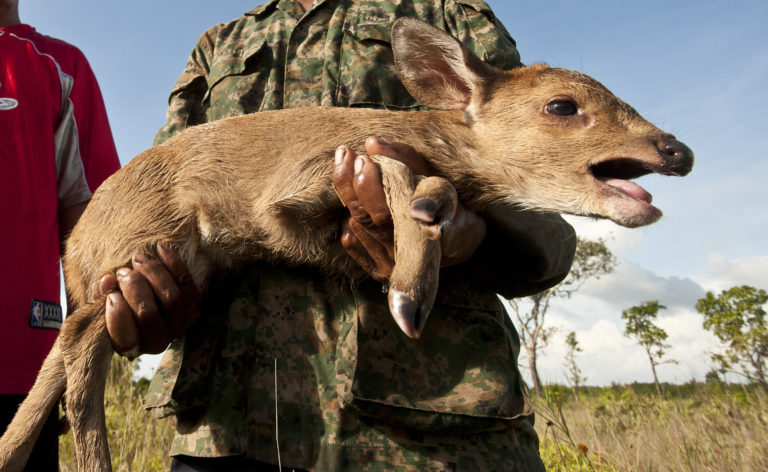
Cambodia’s remaining hog deer is population is under severe hunting pressure
[Credit: Jeremy Holden/FFI]
The extensive and growing use of snares to supply the burgeoning bushmeat market is resulting in the indiscriminate slaughter of wildlife, including Asian elephant calves and other species injured and killed accidentally in wire traps set for other animals.

Groundbreaking research commissioned by Fauna & Flora International (FFI), the first of its kind in Cambodia, has paved the way for a behaviour change campaign to reduce consumption of wild meat. The research has provided vital insights into the phenomenon of bushmeat consumption, shedding light on who eats what, and why.

Bushmeat consumption in Cambodia is not driven by the subsistence needs of impoverished rural communities, who typically rely on fish as their main source of protein. In fact, it is mainly a recreational activity associated with male-dominated gatherings of friends, work colleagues or family members. The practice is linked with peer pressure, social status and – among the elite – the perceived health benefits of eating wild rather than farmed meat.

Eating to extinction: Urban appetite for bushmeat sparks wildlife crisis in Cambodia
Sunda pangolins are among the many species snared to supply the demand for bushmeat
[Credit: Tim Knight]
Almost half of the 24 different wild animals mentioned by the Phnom Penh citizens interviewed during the research stage of the project are threatened with extinction. Several, including the Sunda pangolin – the world’s most trafficked mammal – are officially categorised as Critically Endangered on the IUCN Red List.

Many of those interviewed were oblivious to the fact that some of these animals are on the brink and saw no reason why a previously plentiful resource shouldn’t continue to be readily available. Some of the more knowledgeable consumers are well aware of the increasing scarcity of certain species, but actually regard this as an essential part of their appeal; the prevailing attitude in this case appears to be ‘Buy now while stocks last’.

FFI and its local partners are among the many organisations working to protect Cambodia’s threatened species and habitats through a combination of community engagement, anti-poaching measures and support for improved law enforcement.

Eating to extinction: Urban appetite for bushmeat sparks wildlife crisis in Cambodia
The bushmeat trade poses a threat to critically endangered Siamese crocodiles
[Credit: Jeremy Holden/FFI]
But there is increasing recognition that interventions such as snare removal and prosecution of individual poachers have limited impact in the face of demand-driven commercial hunting. The authorities’ capacity to tackle organised, large-scale wildlife crime is constrained by a shortage of resources and, in some instances, by corruption.

Until now, there has been no real attempt to tackle the problem from a consumer perspective in order to reduce demand for wildlife products in Cambodia. Having identified this gap in the market, FFI is formulating a consumer-focused strategy to complement other, more traditional, approaches to combating illegal wildlife trade. The main target for these activities will be regular consumers in Phnom Penh.

The research techniques employed in compiling the report have been widely utilised in the private sector but are relatively untried in a conservation context. FFI’s Flagship Species Manager, Jackson Frechette, has no doubt about the value of the research: “The findings will be crucial in enabling FFI and partners to decide how best to communicate with the different categories of consumer in order to bring about a change in attitude towards their country’s rich and valuable natural heritage.”

Download the published report here.

Author: Tim Knight | Source: Fauna & Flora International [May 22, 2018]

Scientists analyze first ancient human DNA from Southeast Asia


The first whole-genome analyses of ancient human DNA from Southeast Asia reveal that there were at least three major waves of human migration into the region over the last 50,000 years.

Scientists analyze first ancient human DNA from Southeast Asia
Field workers excavate ancient human remains at Man Bac, Vietnam, in 2007. DNA from skeletons at this site
was included in the current study [Credit: Lorna Tilley, Australian National University]
The research, published in Science, complements what is known from archaeological, historical and linguistic studies of Southeast Asia, defined as the area east of India and south of China.

The work illuminates another critical portion of the story of ancient population dynamics around the world, joining numerous ancient-DNA studies of Europe as well as burgeoning research from the Near East, Central Asia, Pacific Islands and Africa.

"A very important part of the world is now accessible for ancient DNA analysis," said Mark Lipson, a postdoctoral fellow in the lab of ancient-DNA specialist David Reich at Harvard Medical School and first author of the study. "It opens a window into the genetic origins of the people who lived there in the past and those who live there now."

An international team led by researchers at HMS and the University of Vienna extracted and analyzed DNA from the remains of 18 people who lived between about 4,100 and 1,700 years ago in what are now Vietnam, Thailand, Myanmar and Cambodia.

The team found that the first migration took place about 45,000 years ago, bringing in people who became hunter-gatherers.

Then, during the Neolithic Period, around 4,500 years ago, there was a large-scale influx of people from China who introduced farming practices to Southeast Asia and mixed with the local hunter-gatherers.

People today with this ancestry mix tend to speak Austroasiatic languages, leading the researchers to propose that the farmers who came from the north were early Austroasiatic speakers.

"This study reveals a complex interplay between archaeology, genetics and language, which is critical for understanding the history of Southeast Asian populations," said co-senior author Ron Pinhasi of the University of Vienna.

The research revealed that subsequent waves of migration during the Bronze Age, again from China, arrived in Myanmar by about 3,000 years ago, in Vietnam by 2,000 years ago and in Thailand within the last 1,000 years. These movements introduced ancestry types that are today associated with speakers of different languages.

The identification of three ancestral populations -- hunter-gatherers, first farmers and Bronze Age migrants -- echoes a pattern first uncovered in ancient DNA studies of Europeans, but with at least one major difference: Much of the ancestral diversity in Europe has faded over time as populations mingled, while Southeast Asian populations have retained far more variation.

"People who are nearly direct descendants of each of the three source populations are still living in the region today, including people with significant hunter-gatherer ancestry who live in Thailand, Malaysia, the Philippines and the Andaman Islands," said Reich, professor of genetics at HMS and co-senior author of the study. "Whereas in Europe, no one living today has more than a small fraction of ancestry from the European hunter-gatherers."

Reich hypothesizes that the high diversity of Southeast Asia today can be partly explained by the fact that farmers arrived much more recently than in Europe -- around 4,500 years ago compared with 8,000 years ago -- leaving less time for populations to mix and genetic variation to even out.

The new findings make it clear that the multiple waves of migration, each of which occurred during a key transition period of Southeast Asian history, shaped the genetics of the region to a remarkable extent.

"The major population turnover that came with the arrival of farmers is unsurprising, but the magnitudes of replacement during the Bronze Age are much higher than many people would have guessed," said Reich.

Also unexpected were the linguistic implications raised by analyses of the ancestry of people in western Indonesia.

"The evidence suggests that the first farmers of western Indonesia spoke Austroasiatic languages rather than the Austronesian languages spoken there today," Reich added. "Thus, Austronesian languages were probably later arrivals."

Additional samples from western Indonesia before and after 4,000 years ago should settle the question, Reich said.

Source: Harvard Medical School [May 17, 2018]